
Frangipani Home
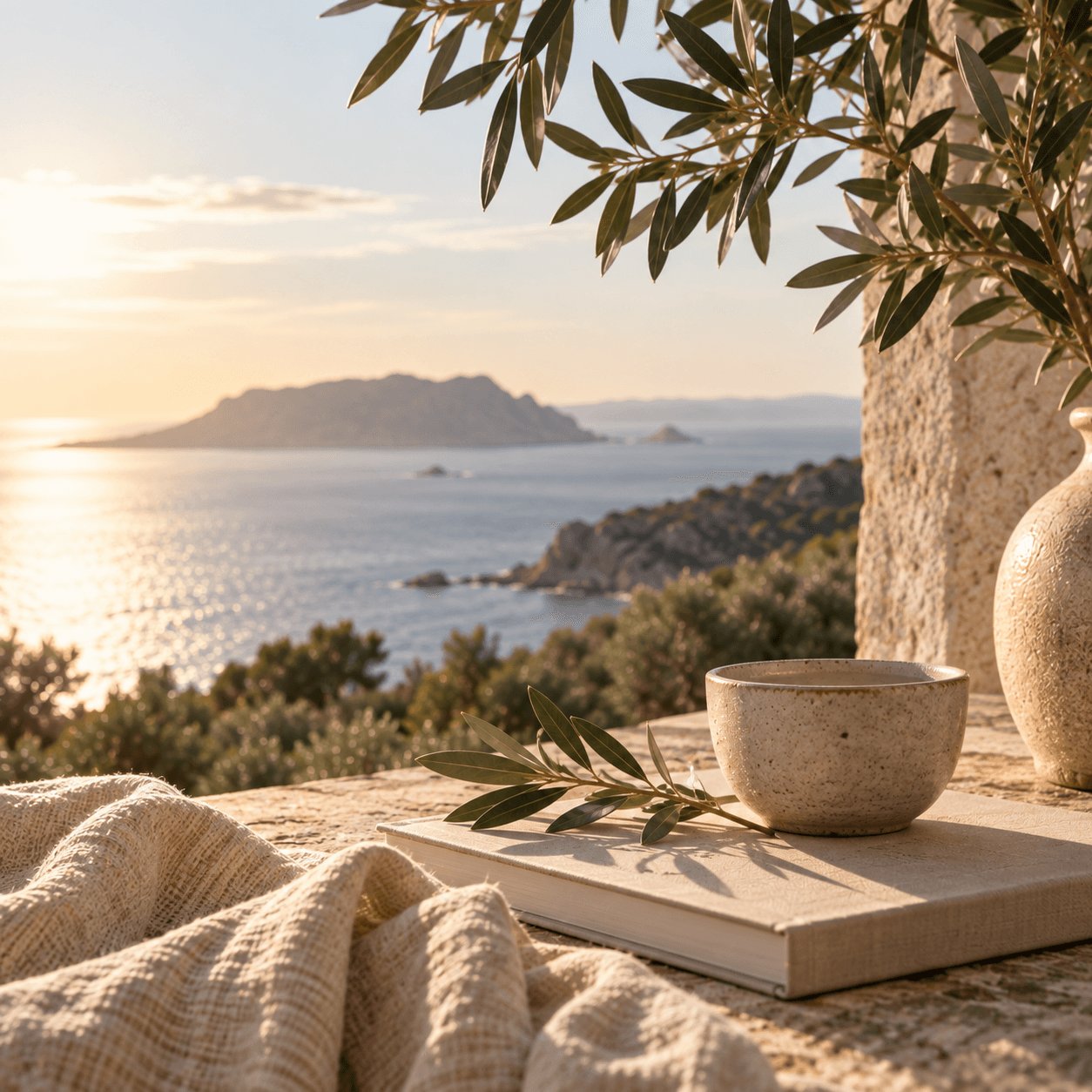
Taccuino, tazza di ceramica e ramo d'ulivo su una terrazza affacciata sul mare al tramonto

Alessia Guttadauro · 24 September 2026

Journal — Persona

When Taking Care of Yourself Becomes Another Job

A reflection on the difference between care and control, and what taking care of yourself actually means.

We've turned wellbeing into a list of things to do.

Eat well.

Sleep enough.

Work out.

Meditate.

Take supplements.

Breathe correctly.

Track your numbers.

Follow a routine.

Optimise your sleep.

Optimise your diet.

Optimise yourself.

And at a certain point, something paradoxical can happen:

Even taking care of ourselves starts to wear us out.

Not because those things don't work.

On the contrary. Sleeping well, eating in a balanced way, moving, recovering, having good habits are all concrete forms of care.

The question is a different one.

When does a practice born to make us feel better turn into just another thing we have to do well?

It's a subtle difference.

But it completely changes the way we experience our wellbeing.

When care becomes control

Control needs to know.

How much am I sleeping?

How many steps am I taking?

How many hours am I training?

How many calories am I eating?

Which supplements should I take?

What's the best protocol?

We measure because knowing gives us a sense of security.

And technology has made it possible to measure almost everything.

There's nothing wrong with that.

The problem arrives when we start trusting the data more than our own experience.

When we've slept badly one night and, instead of asking ourselves how we feel, we only think about how low our sleep score is.

When we skip a workout and feel guilty about it.

When we eat something that doesn't fit our plan and think we've compromised our progress.

When a practice born to support us starts constantly telling us how we should be.

At that point, we're no longer just taking care of ourselves.

We're trying to control ourselves.

The paradox of longevity

It's interesting that all this happens just as longevity has become one of the great themes of our time.

We want to live longer.

And we've started looking for the best way to do it: nutrition, movement, sleep, supplements, biomarkers, technology, protocols.

Everything can be measured. Everything can be optimised.

But there's a question we risk forgetting:

Longer to live how?

Because while we talk about longevity, the world keeps accelerating.

More speed.

More stimuli.

More connections.

More availability.

More productivity.

And often less empty time.

Less silence.

Fewer pauses that don't serve to recover energy for something else.

There's a contradiction that's hard to ignore:

We're trying to add years to our life while we keep living as if time were always too short.

Maybe longevity shouldn't only be a question of duration.

It should also be a question of the quality of the time we pass through.

Because it isn't enough to live longer if the years we add are simply more years spent rushing.

Not everything needs to be optimised

There's a part of life that can't be turned into a protocol.

A walk with no destination.

A lunch that lasts longer than planned.

An evening when we do nothing.

Sleeping without checking the sleep score.

Changing plans because today the body is asking for something else.

Saying no.

Being with someone without watching the clock.

They aren't necessarily wellness practices.

They're life.

And maybe that's exactly what we risk losing when we turn every moment into a tool for feeling better.

Not everything we do needs to produce a result.

Not every habit needs to become a routine.

Not every day needs to be optimised.

Sometimes the body doesn't need another protocol.

It needs us to stop, for a moment, asking something of it.

Care and control aren't the same thing

Care observes. Control measures.

Care adapts. Control applies.

Care leaves room for what's happening. Control tries to anticipate it.

Care doesn't mean paying less attention.

It means paying attention without turning everything into a problem to solve.

We can know our body without becoming obsessed with its numbers.

We can take care of our diet without being afraid of food.

We can train without turning movement into a punishment.

We can be interested in longevity without turning every year into a goal to conquer.

We can use tools, data and technology.

But we can also remember that they're tools, not the point.

Coming back to feeling good inside your own life

Maybe the point isn't finding the perfect routine.

Maybe it's understanding what kind of life truly lets us feel good.

A routine that works on paper but makes us more rigid isn't necessarily a good routine.

A perfect diet that makes us live every meal with anxiety isn't necessarily wellbeing.

A flawless training programme that leaves no room for recovery isn't necessarily health.

And a life built entirely around the idea of living longer risks making us forget a much simpler question:

Am I living well right now?

It isn't a question that needs answering once and for all.

Because we change.

Our body changes, our needs, our work, our relationships, the seasons of our life.

What was good for us a few years ago might not be what we need today.

And this is where care goes back to being something different from control.

It doesn't look for the perfect formula. It looks for the right answer for that moment.

Maybe the real luxury is not having to optimise everything

We live in a time that constantly teaches us to improve.

More productive.

More efficient.

Healthier.

Younger.

Living longer.

But not everything in life needs to become better.

Something can simply be enough.

Enough movement.

Enough rest.

Enough silence.

Enough time together.

Enough time for ourselves.

And maybe we, too, can be enough.

Without becoming the most high-performing, most disciplined, or most optimised version of ourselves.

A thought to carry with you

“Because taking care of yourself shouldn't mean adding another thing to the list. It should let us set the list aside, at least sometimes. And come back to feeling the difference between doing something to feel good and doing something because we think we have to feel good the right way. The difference seems small. But maybe that's exactly where care begins again.”

If this article gave you something to reflect on, I'd be glad to hear your story.

Get in touch

Alessia Guttadauro · Frangipani Home

Back to Journal