
Alessia Guttadauro · 26 October 2026
Journal — Environment
The Light We Stopped Noticing
We spend most of the day under artificial light, assuming it makes no difference. The body, though, still notices.
How much real light do we actually see in a day?
We wake up to an alarm, not to the morning light.
We leave the house while it's still dark, or nearly so. We spend much of the day in offices, shops, cars, closed rooms, under a light that stays exactly the same regardless of what time the clock shows.
We come home as the sun is setting, and switch on a lamp before we'd actually need to.
If we tried to count how many hours, on an ordinary day, we actually spend under natural light, the number would probably be lower than we imagine.
We don't notice, because artificial light is designed precisely so we won't notice the difference.
And that's exactly the point. We've made light so constant, so available at every moment, that we've stopped asking where it comes from and what time it marks.
The body tells time by light
Long before clocks, the body learned to orient itself in time through light.
The shift between light and dark is one of the oldest signals the organism responds to: it regulates when we feel awake, when we start to slow down, when sleep comes more easily.
It's not a mechanism we can choose to ignore entirely. We can only confuse it, by offering it contradictory signals: bright light late at night, dim rooms during the day, entire days spent under the exact same lighting.
When the signals are confused, the body doesn't stop looking for a rhythm. It keeps trying, with whatever information it receives.
Homes built for shade, lived in as if always in shadow
Mediterranean homes grew out of centuries of direct relationship with the sun.
Thick walls, shutters, light curtains, windows oriented to follow the sun's path: not decorative elements, but tools for living well in a climate that alternates intense light with the need for shade.
Opening the shutters in the morning, closing them during the hottest hours, opening them again in the evening: a small daily ritual that marked the day through light, even before the clock did.
Today we tend to replace this relationship with solutions that stay exactly the same: heavy curtains, shutters that almost never open, artificial light set the same way in every season.
That's not necessarily a mistake. But it's a choice worth making consciously, not just out of habit.
Light as the language of a space
When we assess a home, we tend to look first at colours, furniture, proportions.
Light, often, we only notice when it's missing.
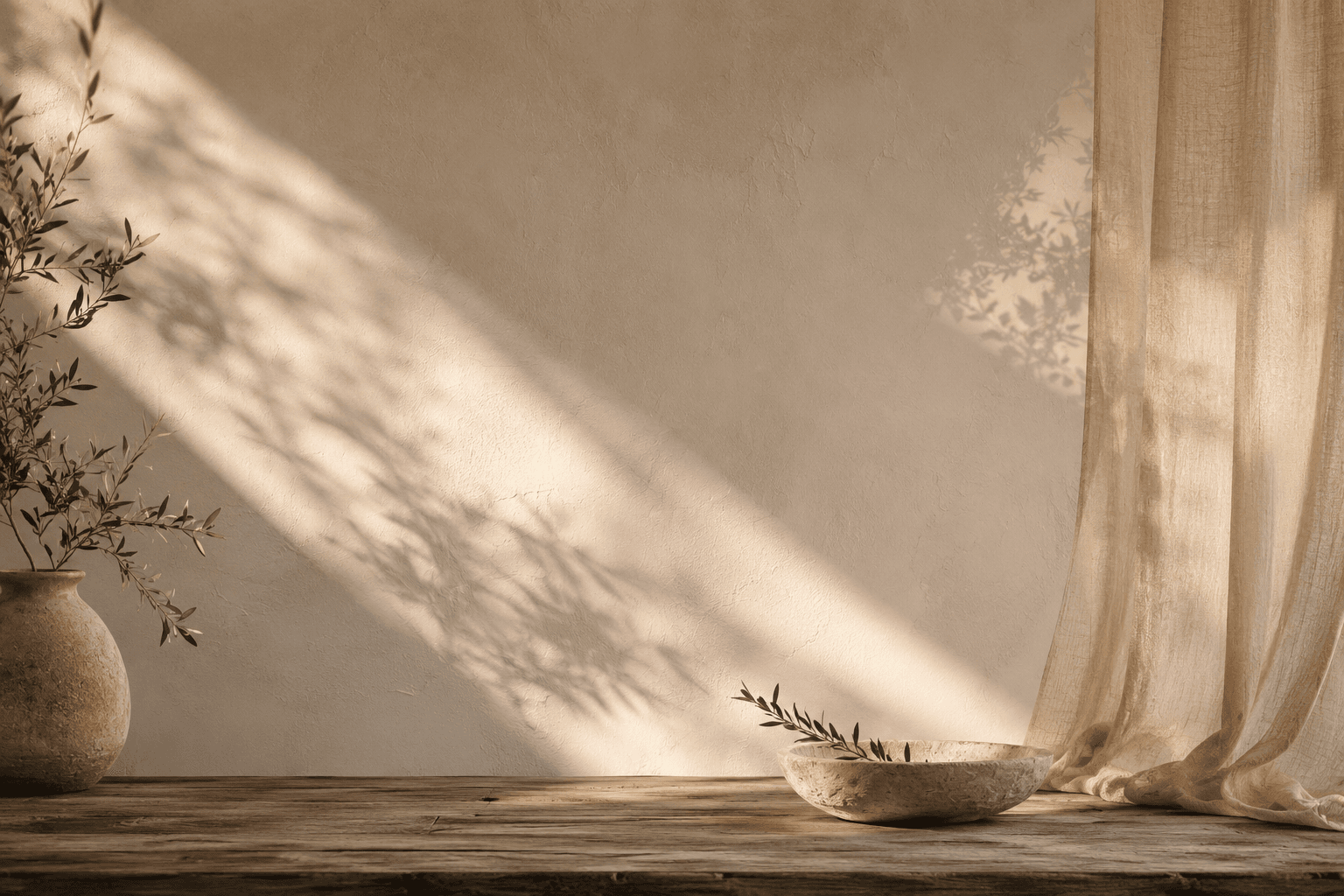
And yet it's one of the elements that most shapes how we feel in a space: a bright room communicates openness, order, breathing room, even when it's small. A room in shadow, even if spacious, can feel heavy.
In Home Staging work, light is often the first thing we address: freeing up a window, choosing curtains that let light through instead of blocking it, placing a mirror where it can help light circulate.
It doesn't always take major changes. Sometimes it's enough to remove what was quietly holding the light back.
Before asking how to make a space more beautiful, it's worth asking how much real light we're actually letting it receive.
Not another thing to optimise
There's a risk, when talking about light, of turning this too into another protocol: specific lamps, apps that measure exposure, precise schedules to follow.
That's not the point.
It's not about measuring how much light we get, but about learning to notice it again: opening a window instead of switching on a lamp, taking a break near the light instead of under a fluorescent tube, letting a room follow the natural rhythm of the day instead of staying identical from morning to night.
It's a small gesture. But it's also one of the simplest ways to put the body and the space back into the same relationship we often talk about in this space.
Looking at the light, not just measuring it
You don't need to become a lighting expert to start paying attention to the light in your home.
It's enough to observe, for a few days, how it moves: where it enters in the morning, where it settles at midday, how it changes in the late afternoon. Which rooms welcome it and which stay the same regardless of the hour.
It's a simple observation, but one we rarely make. We take light for granted, whether it's there or not, without asking why.
For Frangipani Home, this kind of attention is part of the same outlook that guides how we observe a person: not rushing to add a solution, but first learning to look more carefully at what's already around us.
Something to carry with you
“You don't need to measure how much light you get. You need to learn to notice it again — and let it in, into the home and into the day, before switching on a lamp.”
If this article gave you something to reflect on, I'd be glad to hear your story.
Get in touchAlessia Guttadauro · Frangipani Home
Back to Journal