
Frangipani Home
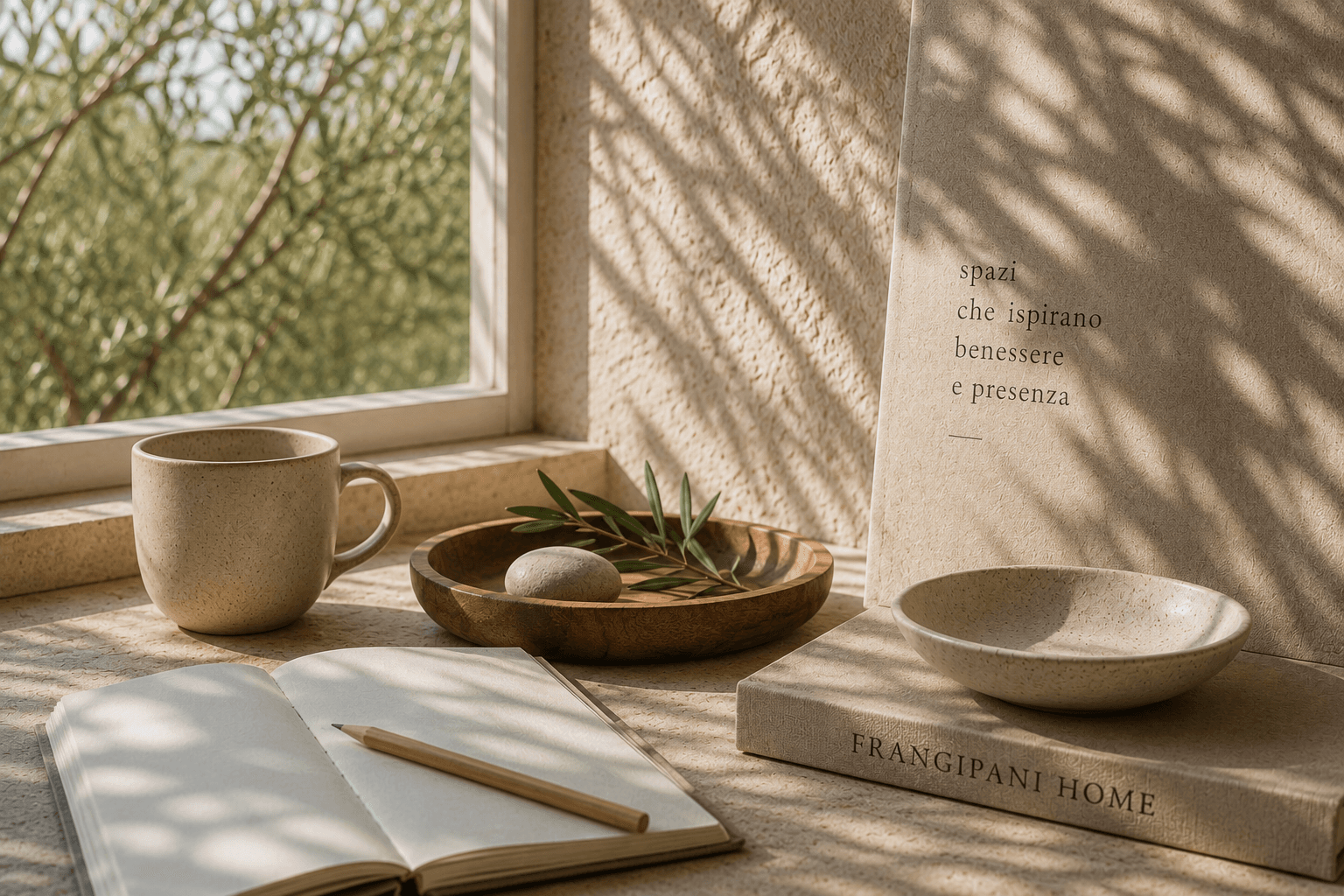
Taccuino, tazza e ramo d'ulivo su un davanzale illuminato dal sole, con il libro Frangipani Home

Alessia Guttadauro · July 28, 2026

Journal — Environment

Does Our Home Take Care of Us? Seven Signs to Observe Every Day

Understanding the language of spaces means learning to read what, often silently, shapes our everyday life.

When we think about wellbeing, we usually imagine nutrition, movement or sleep.

Less often do we stop to look at the place where we spend most of our life.

And yet the home is one of the environments we relate to most.

It doesn't just contain us.

It accompanies us. Every day.

A home doesn't need to be perfect. But it's worth asking whether it's truly supporting the way you live.

Here are seven aspects worth observing.

01

Does light truly enter your day?

Natural light helps mark the rhythm of the day.

A poorly lit home can affect how we perceive time, our level of attention, and the comfort of a space.

Notice which rooms you use most and ask yourself whether you're really making the most of the available light. Sometimes simply rearranging a piece of furniture or lightening a curtain can completely change how a space feels.

02

Do you move naturally through your home?

Every home also tells the story of how we move.

Awkward paths, congested spaces or objects that constantly force you to change direction can increase a sense of disorder, even when everything appears tidy.

Flow is a form of wellbeing.

03

Does your home breathe?

Airing rooms, monitoring humidity and paying attention to air quality are small gestures that contribute to living comfort.

The presence of mould or persistent damp also deserves attention, not only for aesthetic reasons but for the quality of the home environment.

04

Does every room have a clear purpose?

When a room performs too many functions at once, the mind also struggles to find order.

Working, eating, relaxing and sleeping in the same space isn't always a choice.

But even in small spaces, it's possible to create visual boundaries that help the brain distinguish between the different moments of the day.

05

Do you surround yourself with what you actually use?

Every object requires attention.

This doesn't mean living in minimalism.

It means asking whether what surrounds us still has a place in our everyday life. Freeing up space often means freeing up mental energy too.

06

How do you feel when you come home?

This is perhaps the most important question.

When you open the door, do you feel you're returning to a place that welcomes you? Or do you immediately feel the need to tidy, reorganise, or find something?

The answer says far more about a home than its size ever could.

07

Does your home tell the story of who you are today?

People change. Habits change. Needs change.

And yet we often continue to live in spaces designed for a version of ourselves that no longer exists.

Like the body, the home also needs to be listened to and accompanied through change.

Observing before changing

At Frangipani Home we never start with furnishing.

We start with observation.

Every space has its own language, made of light, materials, proportions, functions and atmosphere.

Learning to read it also means understanding our own way of living better.

Because wellbeing doesn't come only from what we do. It also comes from the environments that accompany us every day.

To carry with you

A home shouldn't constantly ask for your energy. It should help you recover it.

If this article gave you something to think about, I'd be glad to hear your story.

Get in touch

Alessia Guttadauro · Frangipani Home

Back to the Journal