
Alessia Guttadauro · September 8, 2026
Journal — Persona
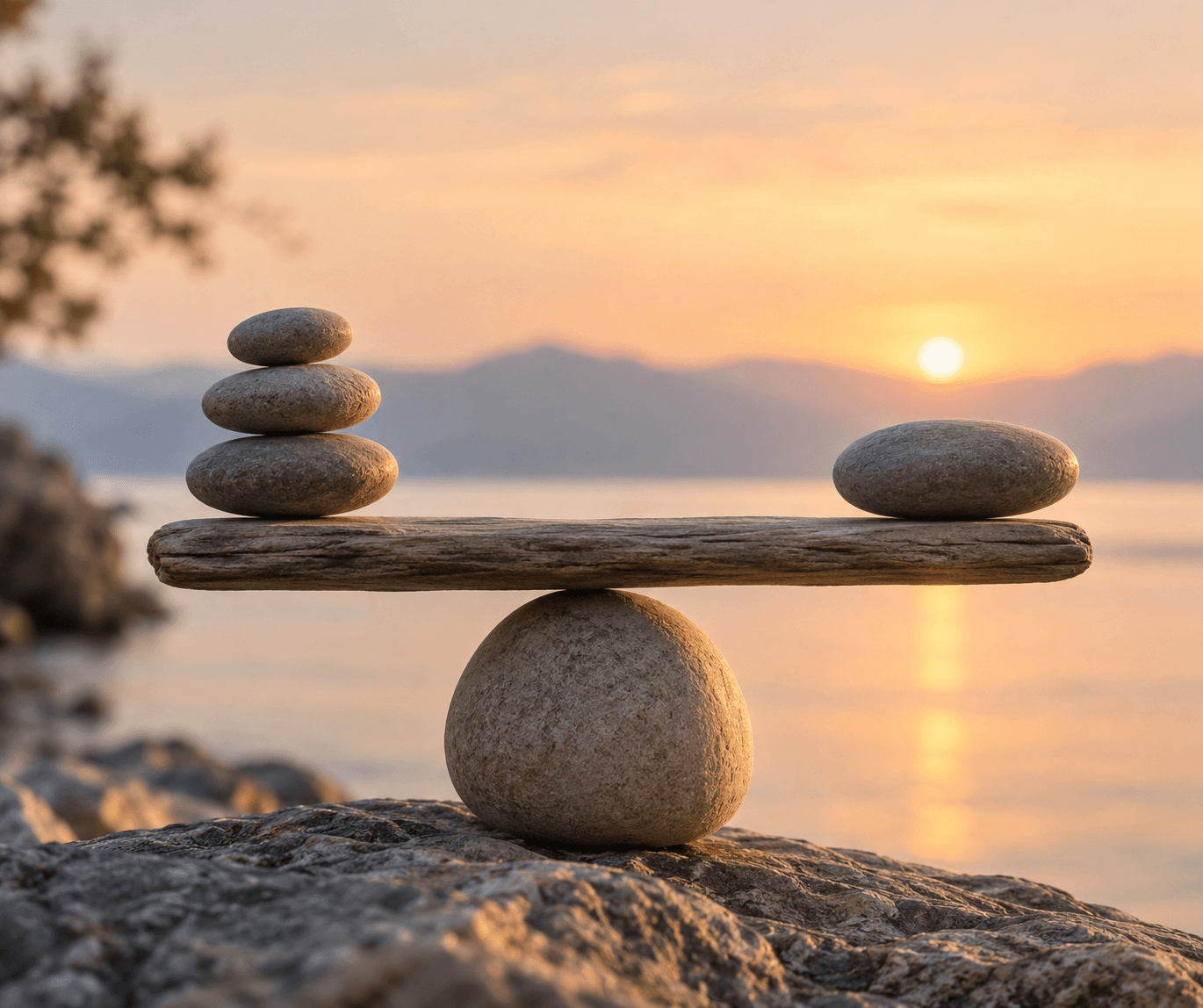
Balance is the key
When what's good for you can become a cause of illness.
In Traditional Chinese Medicine, health isn't a perfect state to be reached once and for all.
It is, first of all, a matter of balance.
Balance between activity and rest, between what we take in and what we use up, between diet, work, physical activity, sexuality, emotions and environment.
And there's an even more important aspect: this balance isn't the same for everyone.
What is enough for one person can be too much for another.
A level of physical exercise that suits someone with a sedentary life might be insufficient for someone with physically demanding work. In the same way, what counts as too much food for one person may be right for another, depending on their energy expenditure and their condition.
This is why, in the view of TCM, there is no rigid model of health that everyone should conform to.
There is the person. Their constitution. Their physical and mental condition. The stage of life they're going through. The way they eat, work, move, rest. And the environment they live in.
When balance is lost
Any alteration that persists over time can become a factor of disharmony.
It can be too much: too much work, too much exercise, too much sexual activity, too much food, prolonged exposure to extreme climate conditions.
But it can also be too little: too much rest, too little physical activity, insufficient nutrition or a poor capacity to recover.
The point, then, isn't to establish what's "right" to do in absolute terms. It's to understand what's right for that person.
And this is exactly where balance becomes something dynamic: it changes with constitution, with age, with the stage of life, and with what is happening to us.
First understand the disharmony, then look for its cause
This principle also changes the way a disorder is observed.
If someone arrives with abdominal pain, the first step isn't necessarily to ask why they have it. First, it's necessary to understand what is happening.
In TCM's diagnostic logic, the aim is to identify the pattern at play: it might be, for example, Liver Qi Stagnation, Cold in the Intestine, or Damp-Heat in the Intestine.
Only after defining the picture does one look to understand its cause. And this is where questions about the person's life come in: diet, emotions, work, physical activity, sexuality, habits and environmental conditions.
Because the same manifestation can have different origins. Liver Qi Stagnation, for example, doesn't on its own establish whether the origin is emotional or dietary: it's the person's own history that provides the necessary elements.
First the pattern. Then the cause.
The cause isn't always found in the same place
The approach also changes when the disharmony is associated with an external pathogenic factor.
If the clinical picture shows the typical signs of an external Wind-Heat attack, the nature of the pattern may already point to the responsible factor. It isn't necessarily useful, then, to reconstruct where and when the person was exposed to wind.
In other cases, though, the case history becomes essential. If, for example, Liver Qi Stagnation is identified, it's necessary to look deeper into the person's history to understand what may have contributed to it.
The cause isn't always sought in the same place: you start from what the body is showing.
The stage of life matters too
TCM also considers it important when a disharmony appeared.
Life is conventionally observed through three broad periods: the prenatal period, childhood and adolescence, and adult life. Each stage has different vulnerabilities.
In childhood, for example, particular importance is given to diet and to the function of the Spleen. During puberty, the changes of body and mind become especially delicate, as does the balance between physical activity, diet and sexual activity.
For women, childbirth and menopause are also important moments of transition. They are passages in which what was normally sustainable may no longer be.
This is why the same habit can have different effects at different stages of life.
The causes of disharmony
In TCM, causes are traditionally divided into three broad categories.
Internal causes: the emotions — anger, joy, sadness, worry and rumination, fear, shock.
External causes: climatic factors.
Other causes: constitution, excessive strain, mental or physical overwork, excessive exercise, excessive sexual activity, diet, trauma, parasites and poisons, incorrect treatments.
To these, in contemporary practice, are naturally added factors that didn't exist when TCM theory was developed, such as pollution, radiation and chemical substances present in the environment and in food.
The principle, however, remains the same: to act on a disharmony, its origin must first be understood.
Balance doesn't mean standing still
This is perhaps the most interesting point.
Balance doesn't mean avoiding all effort. It doesn't mean always resting. It doesn't mean eating by rules that are identical for everyone. It doesn't mean living in perfect conditions.
It means adapting. Adapting what we do to who we are.
And recognising that even what we normally consider positive — exercising, working, eating well, resting — can become a source of imbalance when it loses its personal measure.
Health, from this perspective, isn't something static. It's an ongoing relationship between us and what surrounds us.
And perhaps this is exactly what makes an ancient principle so relevant today: there is no balance without listening.
To carry with you
“Balance isn't the same measure for everyone. What nourishes one person may be too much for another; what supports us today may no longer suit us tomorrow. This is why feeling well doesn't mean following perfect rules, but learning to observe the relationship between what we do and what we need — rest and movement, nourishment and expenditure, activity and recovery, emotions and body. Health isn't the absence of change: it's the ability to recognise when something has shifted, and to find, step by step, one's own balance.”
If this article gave you something to reflect on, I'd be glad to hear your story.
Get in touchAlessia Guttadauro · Frangipani Home
Back to Journal